HR Technology Guide · 2026
The Complete Payroll Process in India — 2026 Guide with Worked Example
The full 3-stage payroll workflow, every statutory deduction (PF, ESI, TDS, PT), and a real Rs. 40,000 salary walkthrough that shows every rupee.
Quick Answer
Payroll processing in India runs in three stages: (1) pre-payroll — freeze attendance, get approvals, verify data; (2) payroll calculation — apply PF, ESI, PT, TDS to gross salary; (3) post-payroll — pay salaries, file returns, archive reports. This guide walks through every stage with a real Rs. 40,000 salary example for a Hyderabad employee.
Payroll looks simple from the outside — salary in, salary out. Inside a real Indian payroll run, it splits into three distinct stages, six deductions, one state-specific slab that changes every year, and filing deadlines that cost money if you miss them. This complete guide walks through every stage of the payroll process in India for 2026, with a real Rs. 40,000 worked example, so you can run the maths yourself or check what your payroll team is doing.
What Is Payroll in India?
Payroll in India is the monthly process of paying employees their salary, cutting the right taxes and contributions, and filing those cuts with the government. It has three parts: earnings (what you owe the employee), deductions (what the law says you must cut), and filings (the returns you send to EPFO, ESIC, income tax, and the state).
The final output of any Indian payroll run is four things: the net pay that lands in the employee bank account, a signed payslip, statutory challan files, and a report that keeps you audit-ready.
Why the Payroll Process Matters
Two reasons. First, employees notice. Cut Rs. 500 too much from a salary and an employee will find out within an hour. Trust in HR drops overnight. Second, the government notices. A late PF ECR upload is Rs. 100 per day per default. A wrong TDS deduction lands in Form 26AS and follows the employee for years.
Get payroll wrong once and you spend a week fixing it. Get it wrong twice in a quarter and finance stops trusting HR. That is why the payroll process deserves the maths care it does not always get.
The 3 Stages of the Payroll Process in India
Every Indian payroll cycle, regardless of company size, follows the same three stages:
- Stage 1 — Pre-Payroll: Data preparation. Freeze attendance, get variable pay approvals, verify master data.
- Stage 2 — Payroll Calculation: Apply every statutory deduction to gross salary, arrive at net pay, generate payslips.
- Stage 3 — Post-Payroll: Push salaries to bank, file returns to EPFO/ESIC/income tax/state, archive reports.
Manual teams typically take 3 to 5 working days to complete all three stages for 50 employees. A modern payroll platform compresses the cycle to under 4 hours.
Stage 1: Pre-Payroll — Data Preparation
Before you open Excel or your payroll software, gather five things:
- Employee master data. Full name, PAN, UAN, bank account, joining date, work location, and CTC structure.
- Salary structure. The split of CTC into Basic, HRA, Special Allowance, DA, and any other allowances.
- Attendance for the month. Total paid days minus loss-of-pay days.
- Leave balances and one-time payouts. Bonuses, arrears, reimbursements, or any deductions.
- Statutory rate table. Current PF and ESI rates, correct Professional Tax slab for each employee state, TDS regime chosen by the employee, and Section 80C to 80U declarations.
If any of these are missing or wrong, every downstream number is wrong. Data cleanup is 80 percent of the pain of running payroll manually.
Attendance and Leave Tracking
Attendance is where most salary errors are born. Every month, someone exports punch data from the biometric system, fixes it in Excel, and imports it into payroll. One wrong loss-of-pay entry and someone gets a full-month salary for a half-month presence. Best practice: reconcile attendance daily, not monthly, and lock inputs one day before payroll processing.
Stage 2: Payroll Calculation — The Full Maths
Once inputs are locked, payroll processing runs in a strict sequence:
- Compute gross earnings: Basic + HRA + allowances
- Subtract loss-of-pay for unpaid leave days
- Apply PF at 12% of Basic + DA
- Apply ESI at 0.75% of gross (if salary is under Rs. 21,000/month)
- Apply Professional Tax by employee state
- Compute monthly TDS on projected annual income minus 80C to 80U declarations
- Deduct any loans, advances, voluntary deductions
What remains is net take-home pay.
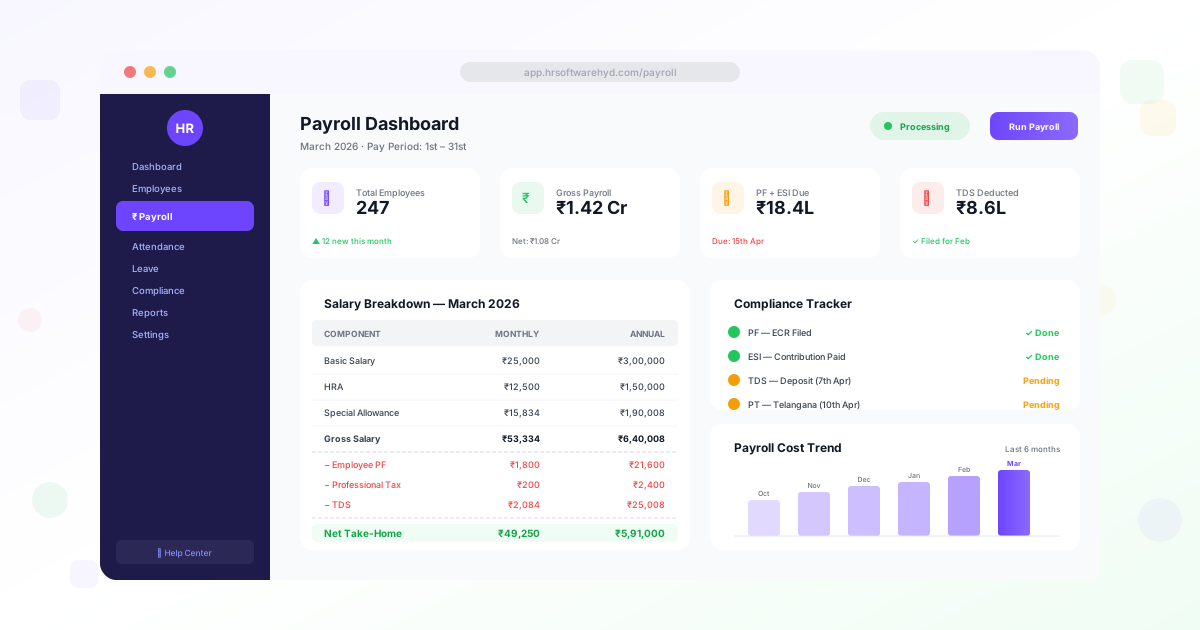
Worked Example: Rs. 40,000 Salary in Hyderabad
Nothing beats a real example. Take Priya, a software engineer in Hyderabad earning Rs. 40,000 gross per month. Here is her payroll for one month, step by step.
Her salary structure
Step-by-step deductions
- Employee PF = 12% of Rs. 16,000 (Basic) = Rs. 1,920
- ESI = Nil (she earns above the Rs. 21,000 threshold)
- Professional Tax (Telangana) = Rs. 200 (top slab for salary above Rs. 20,000)
- TDS (New Regime, FY 2026-27) = Rs. 0 (annual income Rs. 4.8L is under the Rs. 7L rebate)
Her payslip — final numbers
Priya sees Rs. 37,880 in her bank account — 94.7% of her gross. Try any salary yourself in our free CTC calculator.
Statutory Deductions in Indian Payroll — Complete List
Every deduction that can appear on an Indian payslip, in the order most payroll teams calculate them:
1. Provident Fund (PF)
12% employee + 12% employer on Basic + DA (8.33% of employer share goes to EPS). Filed monthly as PF ECR to EPFO by the 15th.
2. Employee State Insurance (ESI)
0.75% employee + 3.25% employer for salaries under Rs. 21,000/month. Filed monthly to ESIC by the 15th.
3. Professional Tax (PT)
State tax. 21 states and UTs levy it. Delhi, Haryana, Punjab, UP, Uttarakhand, Rajasthan, Himachal Pradesh, and Goa do not levy PT. See our Telangana payroll compliance guide for the full state-by-state breakdown.
4. TDS on Salary (Section 192)
Monthly cut based on projected annual income minus employee 80C-80U declarations. Deposit by the 7th of next month. Form 24Q filed quarterly.
5. Labour Welfare Fund (LWF)
State-level. Karnataka collects half-yearly, Maharashtra monthly, at Rs. 6 to Rs. 20 per employee.
6. Gratuity, Bonus, Loans, VPF
Not always cut every month — appear based on service length, Payment of Bonus Act rules, or employee opt-in.
Stage 3: Post-Payroll — Disbursement and Filings
Once you approve payroll:
- Generate payslips and email them to employees (or push to a self-service portal).
- Push net salaries to the bank via NEFT or a bank advice file (HDFC, SBI, ICICI, Axis all accept standard formats).
- Upload PF ECR file to EPFO Unified Portal by the 15th.
- Deposit ESI challan to ESIC by the 15th.
- Deposit TDS to the government by the 7th; file Form 24Q at quarter end.
- Deposit Professional Tax to the state (Telangana: monthly).
- Archive all reports and challans for audit and Form 16 generation at year end.
Payroll Review and Approval Workflow
Before you press “send salaries,” a good process runs three review passes:
- Finance review: Total salary outgo matches the budget forecast.
- HR review: New joiners, exits, and salary revisions all reflected correctly.
- Manager sign-off: Variable pay, bonuses, and reimbursements approved by department heads.
Approval chains catch 90% of preventable errors. Modern payroll software makes this a one-click workflow with audit logs; manual teams should build the same discipline into a checklist.
4 Ways to Run Payroll in India
1. Excel or Google Sheets (0 to 10 employees)
Cheapest, most flexible, most error-prone. Works if you have a technical founder. Breaks the first time PT slabs change.
2. Payroll software (10 to 5,000 employees)
Cloud tools like factoHR, Keka, or GreytHR handle statutory rules automatically. Setup: 2 to 4 weeks. Cost: Rs. 40 to Rs. 150 per employee per month. Compare options in our best payroll software in India guide.
3. Outsourced payroll bureau (50 to 500 employees)
A partner runs payroll and files returns for you. Costs Rs. 150 to Rs. 400 per employee. Fits companies without an HR or finance team.
4. Enterprise HCM with embedded payroll (1,000+ employees)
PeopleStrong, Darwinbox, Oracle, and ADP for multi-entity groups with cross-border payroll needs.
Manual vs. Payroll Software — The Real Comparison
5 Common Payroll Mistakes to Avoid
- Stale PT slabs. States revise slabs quietly. Excel formulas do not auto-update. Fix: use software with managed compliance updates.
- Wrong ESI threshold logic. The Rs. 21,000 threshold is on gross including allowances but excluding bonuses over Rs. 7,500/month. Many teams get this wrong.
- Missed loss-of-pay. Attendance not reconciled with leave means someone gets a full-month salary for a half-month presence.
- Wrong TDS regime. Employees switch between Old and New regimes at year start. Payroll software often defaults to last year’s choice.
- Missing PAN or UAN. No PAN means TDS goes at 20%. No UAN means PF gets stuck in unallocated funds.
Wrapping It Up
The payroll process in India is not hard. It is repetitive, and repetition is where humans make mistakes. Three stages, six deductions, one state-specific slab, one filing calendar. If your team is above 15 people and still running payroll in Excel, the maths in this guide will already be costing you more time than a monthly payroll subscription.
The next step: try running one payroll cycle by hand using the Priya example above, or skip the pain entirely and book a 30-minute demo of an Indian payroll platform that handles every deduction, filing, and PT slab automatically.
Frequently Asked Questions
Run a full payroll cycle on your own data in one demo
Watch PF, ESI, TDS, and Telangana PT run end to end in 30 minutes.
Follow HRSoftware Hyderabad on LinkedIn
Get weekly Telangana HR compliance updates, hiring trends, and SMB HR tips.
→