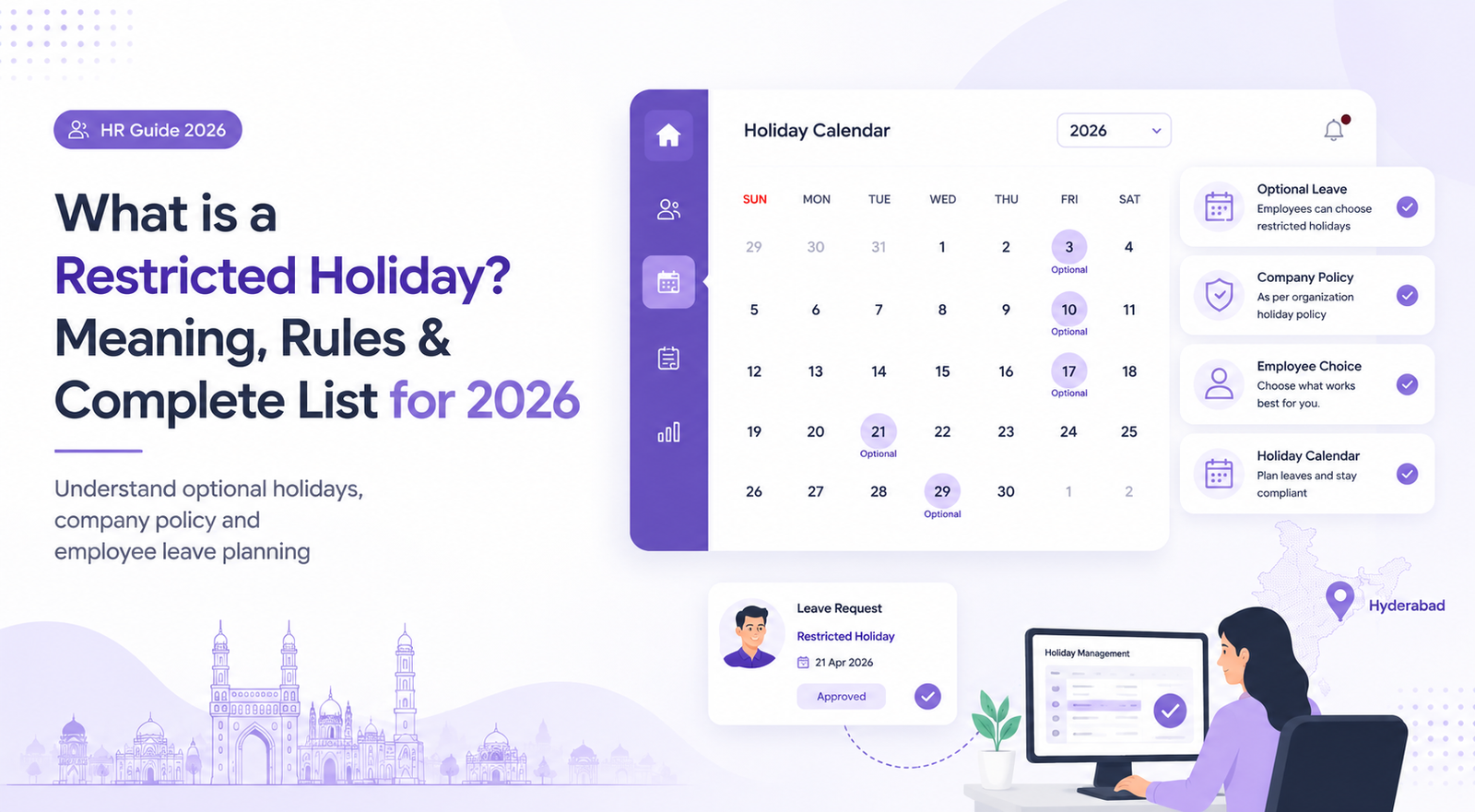
A restricted holiday in India is a paid, optional day off that employees can choose from a government-approved list based on their personal, cultural, or religious preferences. Central government employees can select up to 2 days per year from a list of 30 occasions published by the Department of Personnel and Training (DoPT). Unlike gazetted holidays where all offices close, the organization stays open on restricted holiday days and only approved employees take leave.
India celebrates hundreds of festivals spanning dozens of religions and regional traditions. No single holiday calendar can cover every occasion, which is exactly why restricted holidays exist. They give employees genuine flexibility without requiring blanket shutdowns.
If you manage HR, run payroll, or simply want to understand your own leave rights, this guide covers everything you need to know about restricted holidays in India for 2026.
Quick Answer
RH full form is “Restricted Holiday.” A restricted holiday (RH) is an optional, usually paid day off that an employee can pick from a government-approved list of festivals and observances. You choose the occasion that matters to you, apply in advance, and your manager approves it. Central government staff get 2 RH per year from the DoPT list of 30. It is also called an optional holiday or floater holiday.
RH leave = applying for a restricted holiday
Same as optional / floater holiday
- A restricted holiday (also called an optional or floater holiday) lets employees choose time off for personally significant occasions from a government-published list.
- Central government employees can choose up to 2 restricted holidays per year from the DoPT list.
- Restricted holidays are generally paid for government employees; private sector rules depend on company policy.
- The 2026 DoPT restricted holiday list contains 30 occasions covering Hindu, Muslim, Sikh, Christian, Jain, Buddhist, and Parsi observances.
- A well-configured leave management system removes manual tracking and makes restricted holiday administration effortless.
What is a Restricted Holiday?
A restricted holiday is a day listed by the government on which offices do not close by default, but employees may choose to take the day off. The term “restricted” does not mean the holiday is limited or banned. It means the holiday is available at the employee’s discretion, subject to approval.
The Department of Personnel and Training (DoPT), under the Government of India, publishes two holiday lists every year:
- Gazetted holidays: Mandatory closures for all central government offices. Everyone gets these off.
- Restricted holidays: A longer list from which employees may choose a limited number (usually 2) based on personal, religious, or cultural preference.
Private companies are not legally bound by the DoPT list but many use it as a reference when designing their own leave management policy. State governments also publish their own lists, which may differ from the central list.
Other common names for an RH include optional holiday, floater holiday, and discretionary holiday. Regardless of the label, the concept is the same: the employee picks the day, the employer approves it.
The International Labour Organization has long advocated for inclusive leave policies that respect cultural diversity in the workplace. India’s restricted holiday system is one practical implementation of that principle.
RH Full Form: What Does “RH” Mean on Your Leave Form or Payslip?
RH full form is Restricted Holiday. When you see “RH” on an attendance register, a leave-application dropdown, your HRMS portal, or a payslip, it marks a restricted holiday you applied for or were granted. It is not a deduction or a penalty. It simply records that you took one of your optional festival holidays from the approved list.
Here is what the abbreviation means in each workplace context, so you know exactly what you are looking at:
- RH leave full form (in a leave form): “RH leave” means applying for or taking a Restricted Holiday. It is the leave type you select when you want a festival day off from the optional list, instead of using casual or earned leave.
- RH full form in office / attendance: On an attendance sheet or biometric register, “RH” marks the day an employee took as a restricted holiday. The office still runs normally; only that employee is off.
- RH on a payslip: For government and most private employers, an RH day is fully paid and shows no salary cut. It does not reduce your casual leave (CL) or earned leave (EL) balance.
- RH in a holiday list: Next to a festival, “RH” tells you it is a restricted (optional) holiday, not a gazetted (compulsory) one.
Quick reference for the leave and attendance codes you will see in most Indian HRMS and payroll systems:
| Code | Full Form | What It Means |
|---|---|---|
| RH | Restricted Holiday | Optional festival holiday chosen from an approved list (this guide) |
| RL | Restricted Leave | Used by many companies as another name for a restricted/optional holiday |
| CL | Casual Leave | Short personal leave, usually a few days a month |
| EL / PL | Earned Leave / Privilege Leave | Accrued leave that can usually be carried forward or encashed |
| SL | Sick Leave | Leave for illness, often needing a medical certificate beyond 2 to 3 days |
| CO | Compensatory Off | A day off earned for working on a holiday or weekend |
| LWP | Leave Without Pay | Approved leave with a salary deduction for that day |
So if your question was simply “what is RH leave” or “what does RH mean in office,” the short answer is: it is your Restricted Holiday, a paid optional day off you choose for a festival or personal occasion.
Restricted Holiday vs Gazetted Holiday
Understanding the difference between restricted and gazetted holidays is important for both HR teams and employees. Here is a side-by-side comparison:
| Feature | Gazetted Holiday | Restricted Holiday |
|---|---|---|
| Office closure | All government offices close | Offices remain open |
| Applicability | Mandatory for all employees | Optional, employee chooses |
| Number per year | 17 (central government, 2026) | 30 listed, employee picks up to 2 |
| Approval needed | No (automatic day off) | Yes, requires prior intimation |
| Pay status | Always paid | Paid for govt; varies in private sector |
| Published by | DoPT / State Government | DoPT / State Government |
| Example | Republic Day, Independence Day | Pongal, Guru Nanak Jayanti |
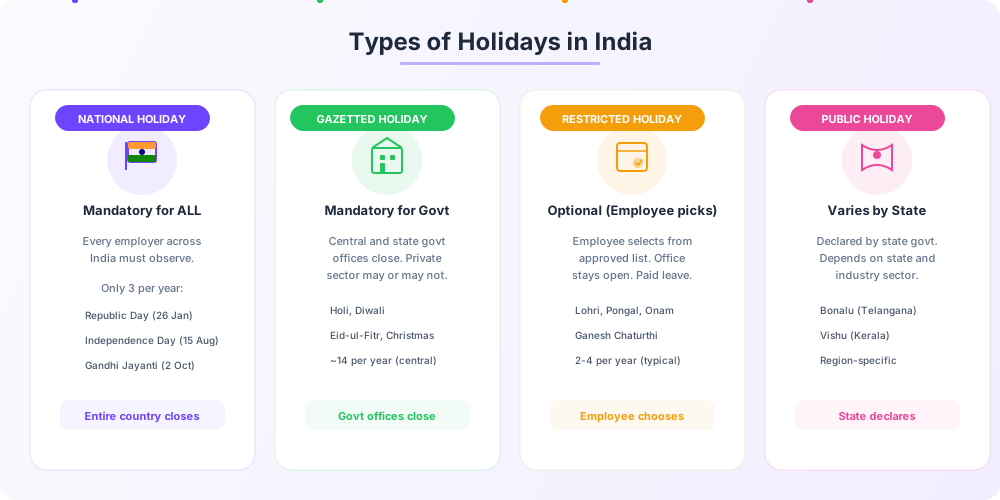
The key distinction is choice. Gazetted holidays are universal and non-negotiable. Optional holidays respect individual preferences by letting each employee select the days that matter most to them.
Restricted Holiday vs Optional Holiday vs Restricted Leave (RL)
These terms confuse a lot of employees because companies use them loosely. Here is the plain-English difference so you do not pick the wrong leave type:
- Restricted Holiday (RH): The official government term used by the DoPT. An optional festival holiday you choose from a published list, with prior approval.
- Optional holiday / floater holiday: The same thing as a restricted holiday. Private companies usually call it “optional” or “floater.” Optional holiday meaning is simply a holiday the employee opts into, instead of a fixed company-wide closure. If your HR policy says “2 floater holidays,” that is your restricted holiday entitlement.
- Restricted Leave (RL): RL leave full form is Restricted Leave. In most Indian companies, RL is just another label for a restricted or optional holiday. In a few organisations, RL instead means leave that is allowed only under certain conditions (for example, specific sandwich-leave rules). Always check how your own leave policy defines RL.
Bottom line: in 9 out of 10 Indian workplaces, restricted holiday, optional holiday, floater holiday, and RL all point to the same idea, which is an employee-chosen day off from an approved festival list. The DoPT term is “restricted holiday,” so that is the wording used through the rest of this guide.
Complete List of Restricted Holidays in India 2026 (DoPT)
The following table shows the full list of restricted holidays for central government employees in 2026, as published by the Department of Personnel and Training. Private companies and state governments may adopt a subset of this list or publish their own. You can verify the official list at india.gov.in/calendar.
| # | Holiday | Date | Day | Type / Religion |
|---|---|---|---|---|
| 1 | New Year’s Day | January 1 | Thursday | General |
| 2 | Lohri | January 13 | Tuesday | Punjabi / Sikh |
| 3 | Pongal / Makar Sankranti | January 14 | Wednesday | Hindu |
| 4 | Basant Panchami / Sri Panchami | February 2 | Monday | Hindu |
| 5 | Guru Ravidas Jayanti | February 12 | Thursday | Sikh / General |
| 6 | Shivaji Jayanti | February 19 | Thursday | Regional (Maharashtra) |
| 7 | Hazrat Ali Birthday | March 11 | Wednesday | Muslim |
| 8 | Holika Dahan | March 13 | Friday | Hindu |
| 9 | Dolyatra | March 14 | Saturday | Hindu (Bengali) |
| 10 | Shab-e-Meraj | March 28 | Saturday | Muslim |
| 11 | Ugadi / Gudi Padwa | March 29 | Sunday | Hindu (Telugu / Marathi) |
| 12 | Chaitra Sukladi | March 29 | Sunday | Hindu |
| 13 | Jamat-ul-Vida | April 3 | Friday | Muslim |
| 14 | Vaisakhi / Vishu | April 14 | Tuesday | Sikh / Hindu (Kerala) |
| 15 | Mesadi / Vaisakhadi | April 14 | Tuesday | Hindu (Bengali / Assamese) |
| 16 | Shab-e-Barat | April 14 | Tuesday | Muslim |
| 17 | Easter Saturday | April 4 | Saturday | Christian |
| 18 | Guru Rabindranath Tagore Jayanti | May 9 | Saturday | General (Bengali) |
| 19 | Rath Yatra | June 23 | Tuesday | Hindu (Odia) |
| 20 | Raksha Bandhan | August 9 | Sunday | Hindu |
| 21 | Janmashtami (Smarta) | August 14 | Friday | Hindu |
| 22 | Onam | September 1 | Tuesday | Hindu (Kerala) |
| 23 | Milad-un-Nabi (Birthday of Prophet Mohammad) | September 27 | Sunday | Muslim |
| 24 | Maha Saptami | October 20 | Tuesday | Hindu (Bengali) |
| 25 | Maha Ashtami | October 21 | Wednesday | Hindu (Bengali) |
| 26 | Maha Navami | October 22 | Thursday | Hindu (Bengali) |
| 27 | Karaka Chaturthi (Karwa Chauth) | October 30 | Friday | Hindu |
| 28 | Naraka Chaturdashi | November 1 | Sunday | Hindu |
| 29 | Govardhan Puja | November 3 | Tuesday | Hindu |
| 30 | Christmas Eve | December 24 | Thursday | Christian |
Central government employees may select any 2 holidays from this list in a calendar year. Some departments allow a third choice in special circumstances, but 2 is the standard entitlement.
Restricted Holidays: State-Wise Variations
India’s federal structure means each state government publishes its own holiday list, which can differ significantly from the central DoPT list. Here is how it works in practice:
How State Lists Differ from the Central List
State governments customize their restricted holiday lists to reflect local festivals and demographics. For example:
- Telangana and Andhra Pradesh include Bathukamma, Bonalu, and Deccan Liberation Day.
- Kerala includes Onam, Vishu, and Thiruvonam as either gazetted or restricted holidays.
- West Bengal has an extensive list covering Durga Puja events (Saptami, Ashtami, Navami) as restricted or optional holidays.
- Punjab adds several Gurpurab and regional Sikh observances to its restricted holiday list.
If your company operates across multiple states, managing overlapping and conflicting holiday lists is one of the most common HR compliance challenges. A centralized HRMS portal with location-based holiday calendars solves this by automatically applying the correct list to each employee based on their work location.
Private Sector Flexibility
Private companies are not bound by the DoPT restricted holiday list. However, most mid-size and large employers in India adopt one of these approaches:
- Use the DoPT list as a starting point and customize it based on workforce demographics.
- Offer a set number of “floater” holidays (typically 2 to 4) that employees can use on any occasion they choose.
- Combine the state government list with additional company-specific optional holidays.
Regardless of the approach, documenting your restricted holiday policy clearly and making it accessible through your leave management system is essential for consistency and compliance.
Are Restricted Holidays Paid or Unpaid?
This is one of the most common questions employees and HR teams have. The answer depends on the sector:
Government Sector
For central and state government employees, restricted holidays are paid. When an employee selects a restricted holiday from the DoPT list and gets approval, they receive their normal salary for that day. There is no deduction in pay or leave balance (the restricted holiday does not consume a casual leave or earned leave day).
Private Sector
In the private sector, the pay status of restricted holidays depends entirely on company policy. There are three common approaches:
- Fully paid: The company treats restricted holidays like any other paid holiday. This is the most employee-friendly approach and is common among large employers.
- Deducted from leave balance: Some companies count a restricted holiday against the employee’s casual leave or privilege leave balance. The employee gets the day off but “pays” for it from their leave quota.
- Unpaid: A small number of companies, particularly startups and very small businesses, may treat optional holidays as unpaid unless the employee uses a regular leave day.
If you run payroll for a company with multiple holiday types, configuring your payroll software to handle restricted holidays correctly is critical to avoid pay discrepancies. Incorrect holiday pay calculations are a common source of employee grievances and payroll compliance issues.
How Many Restricted Holidays Can an Employee Take?
The number of restricted holidays an employee can take varies by employer type:
- Central government: 2 restricted holidays per calendar year from the DoPT list.
- State government: Varies by state. Most states allow 2 to 3 restricted holidays. Some states are more generous.
- Private sector: Depends on company policy. Most companies offer 2 to 4 floater or restricted holidays per year. Some offer up to 5.
Employees cannot exceed their allotted number of RH days, even if the DoPT or state list includes 30 or more occasions. The list provides options; the policy sets the limit.
Eligibility for Restricted Holidays
Eligibility criteria for restricted holidays typically include the following:
- Employment status: The employee must be a confirmed or probationary employee. Contract workers and daily wage earners may or may not be eligible depending on company policy.
- Advance intimation: Employees must inform their supervisor or HR team in advance (usually at least 3 working days before the holiday). Last-minute requests may be denied.
- Approval requirement: A restricted holiday is not automatic. The employee must submit a request through the leave management system or directly to their reporting manager, and it must be approved.
- Cannot be claimed retroactively: If the employee works on a restricted holiday without prior leave approval, they cannot later claim that day as a restricted holiday.
Defining clear eligibility rules in your leave policy helps avoid confusion and disputes. HR leave policy templates can help you get started with a ready-made framework that covers restricted holidays and other leave types.
Restricted Holiday Rules in India
Here are the key rules governing restricted holidays for central government employees. Private companies may adapt these rules in their own policies:
- Restricted holidays are published annually by the DoPT along with the gazetted holiday list.
- An employee may avail a maximum of 2 restricted holidays in a calendar year.
- A restricted holiday can be taken only on the date specified in the list. It cannot be taken on a different date.
- Prior intimation to the controlling officer is mandatory. Requests made on the day itself may be denied.
- A restricted holiday cannot be refused by the employer unless the employee’s presence is essential for urgent work. Even then, the refusal must be documented.
- An RH is not debited from casual leave, earned leave, or any other leave account.
- Half-day restricted holidays are not permitted. Each restricted holiday counts as a full day.
- If a restricted holiday falls on a weekly off or another gazetted holiday, it cannot be substituted with a different date.
For HR teams managing multi-location workforces, keeping track of all these rules across central and state government lists can be challenging. An automated attendance management system integrated with your holiday calendar simplifies compliance by applying the correct rules automatically.
Can Restricted Holidays Be Carried Forward?
No. An RH cannot be carried forward to the next calendar year. If an employee does not use their allotted restricted holidays within the year, they lapse. There is no encashment or accumulation.
This “use it or lose it” rule applies to both government and private sector employees (where the company offers restricted holidays). HR teams should send periodic reminders, especially in Q4, so employees do not lose their entitlement simply because they forgot.
A well-configured leave management system can automate these reminders and display remaining restricted holiday balances on each employee’s dashboard.
Combining Restricted Holidays with Other Leaves
Employees often want to combine a restricted holiday with weekends or other leave types to create a longer break. Here is how it works:
Government Sector Rules
Central government employees can combine a restricted holiday with a weekend to get a longer break (for example, taking a restricted holiday on a Friday gives a three-day weekend). However, there are restrictions on combining restricted holidays with casual leave or other leave types in certain departments. Employees should check their department-specific orders.
Private Sector Practices
Most private companies allow employees to combine restricted holidays with casual leave, privilege leave, or weekends. This is one of the advantages of the restricted holiday system: it gives employees flexibility to plan meaningful breaks around occasions that matter to them.
The Smart Long Weekends section later in this guide shows specific combinations for 2026 that employees can use for extended breaks.
How to Apply for a Restricted Holiday (Step by Step)
Whether you are a government employee or work in the private sector, the process for applying for a restricted holiday typically follows these steps:
Step 1: Check the Restricted Holiday List
Review your organization’s restricted holiday list for the current year. Government employees should refer to the DoPT list. Private sector employees should check their company’s HR portal or leave management system.
Step 2: Verify Your Balance
Confirm how many restricted holidays you have remaining for the year. Most HRMS portal dashboards display this alongside your other leave balances.
Step 3: Submit Your Request in Advance
Apply for the restricted holiday at least 3 working days before the date. Use your company’s leave management tool, email your manager, or follow whatever process your organization requires.
Step 4: Get Approval
Wait for your manager or HR to approve the request. Restricted holidays require approval but cannot be unreasonably denied. If your request is rejected, the employer should provide a valid reason.
Step 5: Confirm on Your Calendar
Once approved, mark the day on your calendar and inform your team so they can plan around your absence.
Using a digital leave management system streamlines this entire process. Employees apply with a few clicks, managers approve from their dashboard, and attendance records update automatically.
HR Manager’s Guide to Restricted Holiday Management
Managing restricted holidays effectively requires clear policies, proper tools, and proactive communication. Here is a practical guide for HR managers:
Draft a Clear Restricted Holiday Policy
Your policy should cover: the number of restricted holidays offered, the approved list of occasions, eligibility criteria, application process, approval workflow, and pay rules (paid, deducted from leave, or unpaid). Reference SHRM guidelines for best practices on structuring inclusive leave policies.
Publish the Holiday List Early
Share the restricted holiday list with all employees at the start of each calendar year. Include it in your onboarding materials for new hires joining mid-year.
Use a Leave Management System
Manual tracking of optional holidays via spreadsheets leads to errors, especially in organizations with 50+ employees. A dedicated leave management system lets you configure restricted holidays as a separate leave type with its own balance, approval rules, and reporting.
Handle Multi-Location Complexity
If your company operates in multiple states, you need location-based holiday calendars. Employees in Hyderabad may celebrate Bathukamma while employees in Kolkata observe Durga Puja. Your system should apply the correct list based on each employee’s work location.
Send Timely Reminders
Many employees forget to use their restricted holidays until December. Send a reminder in October or November to avoid a rush of last-minute requests.
Track and Report
Maintain records of who took which RH days for audit and compliance purposes. This data also helps you understand workforce demographics and plan for future holiday lists. Your HRMS portal should be able to generate these reports with a single click.
If your team needs help setting up restricted holiday workflows in your HR software, our training and support team can walk you through the configuration step by step.
Smart Long Weekends with Restricted Holidays in 2026
One of the biggest benefits of restricted holidays is the ability to plan extended weekends. Here are some smart combinations for 2026:
| Restricted Holiday | Date (Day) | Combine With | Total Days Off |
|---|---|---|---|
| Pongal / Makar Sankranti | Jan 14 (Wed) | Take Thu + Fri CL for a 5-day break (Wed to Sun) | 5 |
| Holika Dahan | Mar 13 (Fri) | Holi is Mar 14 (Sat), giving a 3-day weekend | 3 |
| Janmashtami (Smarta) | Aug 14 (Fri) | Independence Day is Aug 15 (Sat), creating a 3-day weekend | 3 |
| Maha Ashtami | Oct 21 (Wed) | Dussehra on Oct 23 (Fri) + weekend for a 5-day break | 5 |
| Christmas Eve | Dec 24 (Thu) | Christmas on Dec 25 (Fri) + weekend for a 4-day break | 4 |
Planning restricted holidays strategically lets employees maximize their time off without consuming too many casual or earned leave days. Use our CTC Calculator to understand how holiday pay affects your overall compensation structure.
Final Thoughts
Restricted holidays are a simple but powerful way to respect the cultural and religious diversity of India’s workforce. When managed well, they boost employee satisfaction, reduce leave-related disputes, and demonstrate that your organization values inclusion.
For HR teams, the key is having a clear policy, communicating it early, and using the right tools to automate the process. Manual tracking does not scale, and errors in holiday management directly affect payroll accuracy and employee trust.
Whether you are a government office following the DoPT list or a private company designing your own flexible holiday policy, getting restricted holidays right is a small investment that pays off in workforce satisfaction and compliance.
Frequently Asked Questions (FAQs)
A restricted holiday is an optional day off that employees can choose from a government-published list. Unlike gazetted holidays where all offices close, restricted holidays are available at the employee’s discretion with prior approval from their employer.
Central government employees can take up to 2 restricted holidays per calendar year. State government and private sector allowances vary, typically ranging from 2 to 4 per year depending on the employer’s policy.
For government employees, restricted holidays are fully paid with no deduction from any leave balance. In the private sector, pay status depends on company policy. Some companies pay in full, some deduct from leave balances, and a few treat them as unpaid.
In government, a restricted holiday request can only be denied if the employee’s presence is essential for urgent work, and the denial must be documented. In the private sector, approval depends on company policy and operational requirements. Unreasonable refusals can damage employee trust.
There is no practical difference. “Floater holiday” and “optional holiday” are common terms used in the private sector for the same concept as a restricted holiday. All three refer to days an employee can choose to take off based on personal preference from a pre-approved list.
No. An RH expires at the end of the calendar year. They cannot be carried forward, accumulated, or encashed. Employees must use their allotted restricted holidays within the same year or they lapse.
Contract employees may or may not be eligible for restricted holidays depending on the terms of their contract and the employer’s policy. In government, most contract workers are not entitled to restricted holidays. In the private sector, it varies by company.
No. Restricted holidays must be taken as full days. Half-day restricted holidays are not allowed under central government rules, and most private companies follow the same practice.
Each state government publishes its own restricted holiday list reflecting local festivals and cultural events. For example, Telangana includes Bathukamma and Bonalu, while West Bengal includes Durga Puja festivities. Employees should refer to their state government’s official notification for the most accurate list.
A dedicated leave management system automates restricted holiday tracking by maintaining separate leave balances, enforcing policy rules, supporting location-based holiday calendars, sending reminders, and generating compliance reports. This eliminates manual spreadsheets and reduces errors, especially for companies with employees in multiple states.
Want to automate holiday and leave tracking? See pricing or book a free demo.
Related Guides
- Best HRMS Software in India 2026
- HR Software for Small Businesses
- Leave and Attendance Management Guide
Follow HRSoftware Hyderabad on LinkedIn
Get weekly Telangana HR compliance updates, hiring trends, and SMB HR tips.
→