![Performance Management System: Complete Guide for HR Teams [2026]](https://hrsoftwarehyderabad.com/wp-content/themes/hrsoftwarehyd/assets/images/blog/performance-management-system-guide.svg)
Most companies say they care about employee performance. They talk about it in leadership meetings, mention it during onboarding, and include it in their company values. But when you look at what actually happens on the ground, the picture is very different.
Managers avoid giving honest feedback. Goals are set in January and forgotten by March. Reviews happen once a year, feel rushed, and change nothing. High performers get the same treatment as low performers. And the people who are quietly carrying the team start looking for jobs elsewhere.
This is what happens when performance management is treated as a checkbox exercise instead of a real business system.
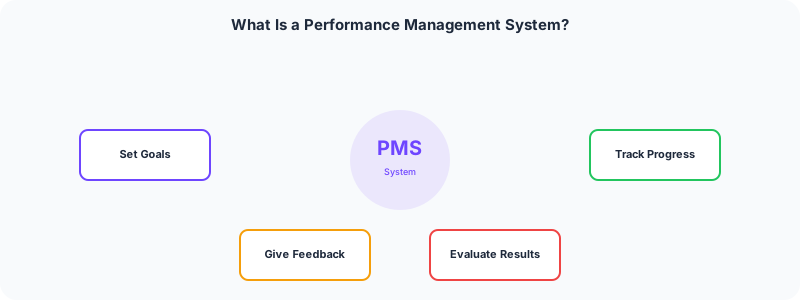
A Performance Management System (PMS) fixes this. It gives organizations a structured, continuous way to set goals, track progress, deliver feedback, and develop people. When done right, it does not just measure performance, it actually improves it.
This guide covers everything you need to know about performance management systems in 2026: what they are, why they matter, how they work, the different types, how to implement one, and how to choose the right software for your organization.
Last updated: March 2026 | Reviewed by Antonio Varghese, SHRM-CP
What Is a Performance Management System?
A Performance Management System is a structured framework that organizations use to align employee activities and outputs with the company’s strategic goals. It includes the processes, tools, and practices used to set expectations, monitor progress, provide feedback, evaluate results, and support employee development on an ongoing basis.
In simpler terms, a PMS answers three questions for every employee:
- What am I expected to do?
- How am I doing?
- How can I do better?
A good performance management system is not just an annual review. It is a continuous cycle that connects individual performance to business outcomes every single day.
Modern performance management software automates much of this process, making it easier for HR teams, managers, and employees to stay aligned without the administrative burden of spreadsheets and manual tracking.
Performance Management vs Performance Appraisal
These two terms are often used interchangeably, but they are fundamentally different. Understanding the distinction matters because confusing them leads to a system that evaluates people without actually helping them improve.
| Dimension | Performance Management | Performance Appraisal |
|---|---|---|
| Nature | Ongoing, continuous process | Periodic event (annual or semi-annual) |
| Focus | Future-oriented (development and growth) | Past-oriented (evaluation of past performance) |
| Approach | Collaborative (manager and employee together) | Top-down (manager evaluates employee) |
| Feedback | Regular, real-time feedback throughout the year | Feedback given once or twice a year |
| Purpose | Improve performance and develop talent | Rate performance and determine compensation |
| Outcome | Growth plans, skill development, alignment | Ratings, rankings, salary decisions |
Performance appraisal is one component of a performance management system, not a replacement for it. Organizations that rely only on annual appraisals miss the continuous feedback, coaching, and goal alignment that actually drive improvement.
Why Does Performance Management Actually Matter?
Performance management is not an HR formality. It is one of the few business systems that directly affects revenue, retention, and culture at the same time. Here is what happens when organizations get it right versus when they do not.
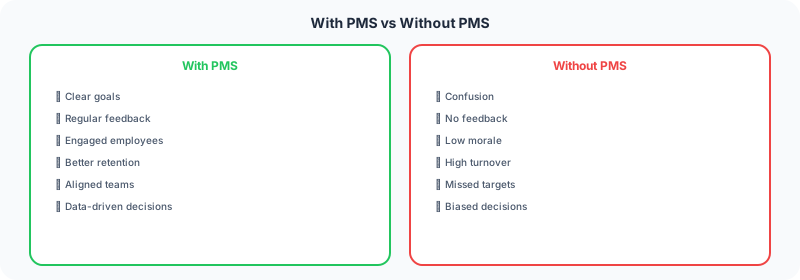
With a Strong Performance Management System
- Employees know exactly what is expected of them and how their work connects to company goals.
- Managers have regular, structured conversations about progress, blockers, and development.
- High performers feel recognized and stay longer.
- Low performance is identified early and addressed constructively.
- Promotion and compensation decisions are based on data, not politics.
- The organization builds a culture of accountability, transparency, and growth.
Without a Performance Management System
- Employees are unclear about priorities and how they are being evaluated.
- Feedback is inconsistent, infrequent, or nonexistent.
- Top talent leaves because they feel invisible or undervalued.
- Underperformance goes unchecked for months or years.
- Compensation decisions feel arbitrary and breed resentment.
- The organization struggles with low morale, high turnover, and stagnant growth.
Key Objectives of a Performance Management System
Every performance management system should serve these six core objectives:
- Align individual goals with organizational strategy. Every employee should understand how their daily work contributes to the bigger picture. When goals cascade from company objectives to team targets to individual KPIs, everyone rows in the same direction.
- Provide continuous, constructive feedback. Waiting 12 months to tell someone how they are doing is too late. A good PMS creates regular touchpoints for managers and employees to discuss progress, recognize wins, and course-correct early.
- Identify and develop talent. Performance management should surface your future leaders, your skill gaps, and your development needs. It is the foundation for succession planning and career pathing.
- Support fair, data-driven decisions. Promotions, raises, bonuses, and role changes should be based on documented performance data, not gut feeling. A well-run PMS eliminates bias and builds trust in organizational decisions.
- Improve employee engagement and retention. When people feel seen, heard, and supported in their growth, they stay. Performance management is one of the most powerful levers for reducing voluntary turnover.
- Build a culture of accountability. A transparent system where everyone knows what is expected, how they are performing, and what happens when targets are met (or missed) creates genuine accountability at every level.
The Performance Management Process: 5 Steps
Performance management is not a single event. It is a continuous cycle with five interconnected stages. Skipping any stage weakens the entire system.
Step 1: Planning and Goal Setting
This is where everything starts. Managers and employees collaborate to set clear, measurable goals that align with team and company objectives. Goals should follow the SMART framework: Specific, Measurable, Achievable, Relevant, and Time-bound.
Best practice: Set 3 to 5 goals per quarter, not 15. Fewer, focused goals produce better results than a long list of vague targets.
Step 2: Continuous Monitoring
Once goals are set, progress needs to be tracked regularly, not just at the end of the year. This means weekly or biweekly check-ins, real-time progress updates, and early identification of blockers or shifting priorities.
Best practice: Use a shared dashboard or performance management tool where both the manager and employee can see goal progress at any time.
Step 3: Development and Support
When gaps are identified, the system should trigger development actions: training, mentoring, stretch assignments, or additional resources. Performance management is not just about measurement, it is about helping people improve.
Best practice: Create individual development plans (IDPs) for every employee, reviewed quarterly.
Step 4: Periodic Review and Evaluation
At defined intervals (quarterly is ideal), conduct formal reviews that summarize progress, capture feedback from multiple sources, and document performance against goals. This is where performance appraisal fits within the broader system.
Best practice: Combine self-assessment, manager evaluation, and peer feedback for a complete picture.
Step 5: Recognition, Rewards, and Action
Performance data should directly inform decisions about compensation, promotions, role changes, and recognition. High performance should be visibly rewarded. Consistent underperformance, after coaching and support, should lead to clear consequences.
Best practice: Tie at least a portion of variable pay to documented performance outcomes, not subjective manager impressions.

Core Functions of a Performance Management System
A well-designed PMS performs six core functions that work together to create a complete performance ecosystem:
- Goal management. Setting, cascading, and tracking goals from the organizational level down to individual contributors. This includes OKRs (Objectives and Key Results), KPIs (Key Performance Indicators), and project-based targets.
- Continuous feedback. Enabling real-time feedback between managers and employees, peer-to-peer recognition, and structured check-ins. The goal is to make feedback a regular habit, not a dreaded annual event.
- Performance reviews. Conducting structured evaluations at regular intervals using standardized criteria, self-assessments, manager ratings, and multi-source (360-degree) feedback.
- Development planning. Identifying skill gaps, creating individual development plans, tracking learning progress, and connecting performance insights to training and career growth opportunities.
- Analytics and reporting. Generating data on team and individual performance trends, identifying patterns (such as consistently high or low performers), and providing leadership with actionable workforce insights.
- Compensation linkage. Connecting performance outcomes to rewards, including merit increases, bonuses, promotions, and non-monetary recognition. This function integrates directly with payroll systems to ensure accurate and timely compensation adjustments.
Types of Performance Management Systems
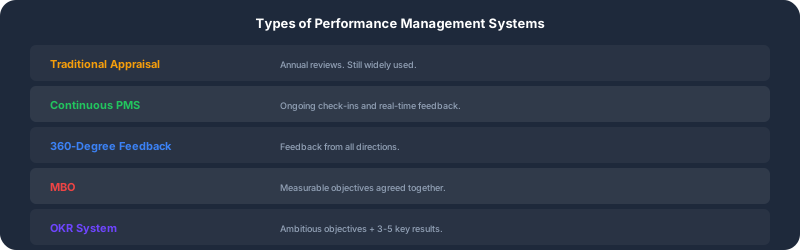
Not all organizations manage performance the same way. The right approach depends on your company’s size, culture, industry, and strategic priorities. Here are the five most common types:
1. Traditional (Annual Review) System
The classic approach: set goals at the beginning of the year, review performance at the end. It typically involves manager-only evaluations, numerical ratings, and a forced ranking or bell curve.
Best for: Organizations with stable, predictable work where goals do not change frequently.
Limitations: Feedback is too infrequent. Recency bias dominates reviews. Employees disengage between review cycles. Many large organizations (including Deloitte, Adobe, and Microsoft) have moved away from this model.
2. Continuous Performance Management
This replaces the annual cycle with ongoing check-ins, real-time feedback, and quarterly (or even monthly) goal reviews. It emphasizes coaching over evaluation and forward-looking development over backward-looking ratings.
Best for: Fast-moving organizations, tech companies, startups, and any business where priorities shift frequently.
Limitations: Requires a high level of manager commitment. Can feel unstructured without good software support.
3. OKR-Based System (Objectives and Key Results)
Made popular by Google and Intel, OKRs set ambitious qualitative objectives paired with measurable key results. Goals are typically set quarterly, are transparent across the organization, and are designed to stretch teams beyond what feels comfortable.
Best for: Innovation-driven companies that want to push boundaries and maintain organizational alignment at scale.
Limitations: Can feel intimidating if not implemented carefully. Requires organizational maturity and psychological safety to work well.
4. 360-Degree Feedback System
This system collects performance feedback from all directions: managers, peers, direct reports, and sometimes even clients or external stakeholders. It provides a comprehensive view of an employee’s strengths, blind spots, and interpersonal effectiveness.
Best for: Leadership development, management effectiveness assessments, and organizations that value collaboration and interpersonal skills.
Limitations: Time-intensive to administer. Results can be skewed by personal relationships or politics if not anonymized and structured properly.
5. Balanced Scorecard System
Originally a strategic management framework, the balanced scorecard evaluates performance across four dimensions: financial results, customer satisfaction, internal processes, and learning and growth. It connects individual performance to the organization’s strategic map.
Best for: Large organizations, especially those in regulated industries that need to balance multiple performance dimensions simultaneously.
Limitations: Complex to set up and maintain. Requires significant leadership involvement to define and cascade scorecards effectively.
Key Components of an Effective Performance Management System
Regardless of which type of PMS you choose, these six components must be in place for the system to work:
1. Clear and Aligned Goals
Goals must be specific, measurable, and directly connected to team and organizational objectives. Vague goals like “do better” or “improve communication” are useless. Every employee should be able to explain, in one sentence, what their top priorities are and why they matter to the business.
2. Regular One-on-One Meetings
Structured check-ins between managers and their direct reports are the backbone of continuous performance management. Weekly or biweekly one-on-ones keep feedback flowing, build trust, and catch issues before they escalate. These should not be status updates. They should be genuine conversations about performance, development, and support.
3. Multi-Source Feedback Mechanisms
Relying on a single manager’s perspective is not enough. Effective systems incorporate self-assessments, peer reviews, upward feedback (from direct reports), and where relevant, client or cross-functional input. This creates a more complete and fair picture of performance.
4. Individual Development Plans (IDPs)
Every employee should have a documented development plan that identifies their growth areas, the skills they need to build, the actions they will take, and the timeline for progress. IDPs transform performance management from an evaluation tool into a growth engine.
5. Data and Analytics
Without data, performance management is just opinions. The system should track goal completion rates, feedback frequency, review scores, development progress, and team-level trends. Leaders need dashboards that surface insights, not just data dumps.
6. Technology Platform
Trying to run performance management on spreadsheets and email threads breaks down at any meaningful scale. A dedicated software platform centralizes goals, automates review cycles, captures feedback, generates reports, and integrates with your broader HR stack including employee self-service portals and payroll.
How to Implement a Performance Management System
Implementing a PMS is not just a software purchase. It is an organizational change that requires planning, communication, and sustained commitment. Here is a seven-step implementation roadmap:
Step 1: Define Your Objectives
Before selecting any tool or framework, be clear about what you want the system to achieve. Are you trying to improve goal alignment? Reduce turnover? Build a feedback culture? Support promotion decisions? Your objectives will shape every subsequent decision.
Step 2: Choose the Right Framework
Based on your objectives, company size, and culture, select the performance management approach that fits: traditional reviews, continuous management, OKRs, 360-degree feedback, or a hybrid. Most growing organizations in 2026 are moving toward continuous management with quarterly OKR cycles.
Step 3: Get Leadership Buy-In
Performance management only works when leaders model it. If senior leadership does not participate in goal setting, conduct their own reviews, and take feedback seriously, the rest of the organization will not either. Present the business case with data: retention impact, productivity gains, and the cost of doing nothing.
Step 4: Select and Configure the Software
Choose a performance management platform that matches your framework and integrates with your existing HR systems. Configure goal templates, review cycles, feedback workflows, rating scales (if applicable), and reporting dashboards. The software should reduce administrative work, not create more of it.
Step 5: Train Managers First
Managers are the make-or-break factor. Train them on how to set effective goals, conduct meaningful one-on-ones, deliver constructive feedback, and use the software platform. Do not just send a PDF guide. Run interactive workshops and provide ongoing coaching.
Step 6: Communicate and Launch
Roll out the system with clear communication about why it exists, how it works, what is expected of everyone, and how it benefits employees (not just the company). A phased rollout, starting with one department or team, is often more effective than a company-wide launch on day one.
Step 7: Monitor, Iterate, and Improve
After launch, track adoption metrics: Are managers completing check-ins? Are goals being updated? Are reviews happening on time? Collect feedback from users quarterly and iterate on the process. No system is perfect at launch. The organizations that succeed are the ones that keep improving.
Common Mistakes to Avoid
- Making it too complicated. If the system requires hours of admin work per employee, no one will use it. Start simple and add complexity over time.
- Treating it as an HR project. Performance management is a business initiative, not an HR initiative. It needs ownership from leadership, not just the HR team.
- Focusing only on ratings. If the entire system revolves around a 1-to-5 rating at year-end, you have built a performance appraisal, not a performance management system.
- Ignoring manager capability. The best software in the world will not fix a manager who does not know how to give feedback or set goals. Invest in manager development first.
- Launching without follow-through. The most common failure mode is a strong launch that fizzles within six months. Assign ongoing ownership, track metrics, and hold leaders accountable for using the system consistently.
Choosing the Right Performance Management Software
The software you choose should match your organization’s needs, not the other way around. Here is what to look for:
Must-Have Features
- Goal setting and OKR tracking with cascading alignment.
- Configurable review cycles (quarterly, semi-annual, annual, or custom).
- 360-degree feedback and multi-rater evaluations.
- Continuous feedback and recognition tools.
- One-on-one meeting agendas and notes.
- Performance analytics dashboards and exportable reports.
- Integration with payroll and core HR systems.
- Mobile access for managers and employees.
Evaluation Criteria
- Ease of use: If managers and employees find it cumbersome, adoption will fail. Prioritize clean, intuitive interfaces.
- Configurability: Your PMS process is unique. The software should adapt to your workflows, not force you into a rigid template.
- Integration: It should connect seamlessly with your HRMS, payroll, and communication tools (Slack, Teams, email).
- Scalability: Choose a platform that works for your current size and can grow with you to 5x or 10x headcount.
- Support and implementation: Look for vendors who offer hands-on implementation support, manager training, and a dedicated customer success team.
- Pricing transparency: Understand exactly what is included. Check pricing details before committing. Hidden fees for additional modules, users, or features are a red flag.
Software Options for Indian Organizations
For organizations based in India, especially in Hyderabad and Telangana, consider platforms that offer:
- Telangana and AP compliance integration for seamless payroll-performance linkage.
- Support for Indian appraisal cycles (April to March financial year alignment).
- Local implementation and support teams.
- Pricing in INR with no currency conversion overhead.
Popular options in the Indian market include greytHR, Keka, Darwinbox, Zoho People, and HRSoftware Hyderabad. When evaluating, prioritize depth of performance management features over brand recognition. Many well-known platforms have strong payroll but shallow performance management modules.
Start Building a Performance Culture Today
A performance management system is not a nice-to-have. It is the operating system for how your organization sets expectations, develops people, and drives results. Without one, you are leaving performance to chance. With one, you are building a culture where accountability, growth, and recognition are embedded into how work gets done every day.
The best time to implement a performance management system was years ago. The second-best time is now.
If you are ready to move from annual appraisals to a continuous, data-driven performance culture, schedule a demo and see how the right system can transform how your organization manages and develops its people.
Frequently Asked Questions
What is a Performance Management System?
A Performance Management System (PMS) is a structured framework that organizations use to set employee goals, monitor progress, provide ongoing feedback, conduct evaluations, and support professional development. It connects individual performance to organizational strategy through continuous processes rather than one-time annual reviews. A well-implemented PMS helps businesses improve productivity, retain top talent, and make fair, data-driven decisions about compensation and promotions.
What is the difference between performance management and performance appraisal?
Performance management is a continuous, year-round process that includes goal setting, regular feedback, coaching, development, and evaluation. Performance appraisal is a single event, typically conducted once or twice a year, that focuses on rating past performance. Appraisal is one component of the broader performance management system. Organizations that rely only on appraisals miss the ongoing feedback and development that actually improve performance.
What are the 5 steps in the performance management process?
The five steps are: (1) Planning and goal setting, where managers and employees collaboratively define clear, measurable objectives. (2) Continuous monitoring, where progress is tracked through regular check-ins and real-time updates. (3) Development and support, where skill gaps are addressed through training, mentoring, and coaching. (4) Periodic review and evaluation, where performance is formally assessed against goals. (5) Recognition, rewards, and action, where outcomes inform compensation, promotions, and development decisions.
What are the different types of performance management systems?
The five main types are: Traditional (annual review) systems that evaluate performance once a year. Continuous performance management that uses ongoing check-ins and real-time feedback. OKR-based systems (Objectives and Key Results) that set ambitious quarterly goals with measurable outcomes. 360-degree feedback systems that collect input from managers, peers, direct reports, and clients. Balanced scorecard systems that evaluate performance across financial, customer, process, and learning dimensions. Most modern organizations use a hybrid approach combining elements from multiple types.
How often should performance reviews be conducted?
The best practice in 2026 is quarterly formal reviews supplemented by weekly or biweekly informal check-ins. Annual reviews alone are too infrequent to drive meaningful improvement. Quarterly reviews keep goals relevant as business priorities shift, give employees regular feedback to act on, and prevent the recency bias that plagues annual evaluations. The informal check-ins between formal reviews are equally important for maintaining momentum and catching issues early.
What features should I look for in performance management software?
Essential features include: goal setting and OKR tracking with cascading alignment, configurable review cycles, 360-degree feedback and multi-rater evaluations, continuous feedback and recognition tools, one-on-one meeting support, performance analytics dashboards, integration with payroll and core HR systems, and mobile access. For Indian organizations, also look for support for April-to-March financial year cycles, local compliance integration, INR pricing, and local implementation support.
How long does it take to implement a performance management system?
For most mid-size organizations (100 to 1000 employees), a well-planned implementation takes 4 to 8 weeks. This includes defining your performance framework, configuring the software, training managers, piloting with one team, and rolling out company-wide. The software setup itself is often the fastest part. The real investment is in manager training and change management. Organizations that rush implementation without proper training see poor adoption rates regardless of how good the software is.
Can a performance management system help reduce employee turnover?
Yes, and the impact is significant. Employees who receive regular feedback, have clear goals, see a path for development, and feel recognized for their contributions are far less likely to leave. A well-run performance management system addresses the top reasons people quit: feeling undervalued, lack of growth opportunities, poor management, and unclear expectations. Organizations with strong performance management practices consistently report lower voluntary turnover rates compared to those without structured systems.